A hiring mistake in a Global Capability Center rarely looks costly on the offer date. The real cost appears later.
A project slows down. A manager spends extra hours correcting work. The team waits longer for output. A client escalation becomes harder to manage. A strong employee starts carrying the load. Then the role opens again, and the company enters another hiring cycle.
This is why quality of hire in GCC hiring deserves more attention than many dashboards give it. Time-to-fill, cost-per-hire, offer acceptance rate, and joining ratio are useful metrics. But they do not show whether the person hired is performing well after joining.
India’s GCC ecosystem has moved far beyond back-office support. GCCs now own product engineering, AI, analytics, cybersecurity, finance operations, cloud platforms, HR technology, recruitment operations, and global business processes. In this kind of environment, a mid-level or senior hire can affect multiple vacancies. It can slow delivery, drain leadership time, and reduce trust in the hiring process.
The better question is not “How fast did we close the role?”
The better question is, “Did this hire create the business outcome we expected?”
Why GCC Hiring Quality Needs a Stronger Measurement Model
India’s GCC market is no longer a small extension of global operations. The Zinnov-Nasscom India GCC Landscape Report 2026 reports 2,117 GCCs in India, $98.4 billion in revenue, 2.36 million professionals, and 506 Forbes Global 2000 companies operating GCCs in the country.
That scale changes the hiring conversation.
GCCs are competing for product engineers, data scientists, cybersecurity professionals, cloud architects, finance specialists, AI talent, HR technology experts, and global operations leaders. When the wrong person enters a key role, the impact is not limited to salary cost. It can affect sprint speed, control quality, reporting accuracy, system rollout, stakeholder belief, or customer delivery.
The commercial real estate market also shows how strongly GCC expansion is molding India’s business landscape. Reuters reported that India’s office leasing reached 45.5 million square feet in the first half of 2026, up 9.6% year over year, with GCCs accounting for 43% of all leases and 53% of large-space transactions above 100,000 square feet.
But office expansion alone does not create capability. Talent quality does.
A GCC can lease more space, hire more people, and open new functions. Still, if hiring quality is measured too late, the cost of poor selection spreads quietly across teams.
The Cost of a Hiring Mistake Is Not One Standard Percentage
Many hiring articles repeat the claim that a poor hire costs a fixed percentage of annual salary. That may be useful as a rough warning, but it is too simple for GCC hiring.
The cost changes by:
- Role level
- Skill rarity
- Notice period
- Replacement speed
- Training time
- Manager dependency
- Project impact
- Client or stakeholder exposure
- Time needed to reach productivity
A Center for American Progress review of case studies found that the typical median cost of turnover was about 21% of annual salary for many roles, excluding executives and physicians. But that figure relates to turnover cost, not the full business damage of a poor hire in a specialist or leadership role.
For a GCC, a hiring mistake can include more than the replacement cost. It can include delayed releases, missed controls, rework, stakeholder pressure, and lost team confidence.
So the useful question is not, “What is the market percentage?”
The useful question is, “Where does the cost appear in our operating model?”
What a GCC Bad-Hire Cost Model Should Include
A practical cost model should separate direct costs from indirect costs.
Direct hiring costs
These are easier to see because they often sit in recruitment or HR budgets:
- Recruiter time
- Agency fees
- Job-board spend
- Sourcing tools
- Assessment costs
- Interview panel time
- Background checks
- Onboarding time
- Training cost
- Salary paid during low productivity
- Replacement recruitment
Indirect business costs
These are harder to track but often more expensive:
- Manager correction time
- Team disruption
- Rework
- Missed service levels
- Slower project delivery
- Lower stakeholder trust
- Delayed decisions
- Reduced morale
- Extra workload on strong employees
- Risk of early attrition from other team members
In India, notice periods can slow down replacement, especially for mid-senior and senior roles. If a hire does not work out, the team may wait months before the next person joins and becomes productive. The cost is not only the salary paid to the wrong person. It is also the output that the team lost while waiting for the right person.
Quality of Hire Is a Scorecard, Not a Single Metric
Quality of hire is often discussed as one number. In practice, it is better treated as a scorecard.
LinkedIn’s Future of Recruiting 2025 notes that quality of hire is usually calculated through a mix of other metrics. The most common inputs are job performance ratings, used by 66% of talent acquisition professionals; new-hire retention, at 60%; and hiring manager satisfaction, at 44%.
For GCC hiring, a practical quality-of-hire score can include:
- Performance after 90 or 180 days
- Time to productivity
- Hiring manager satisfaction
- Retention through 6 or 12 months
- Role-specific output quality
- Team or stakeholder feedback
- Ramp-up versus the original success profile
The key is to define the success standard before hiring begins. If the success criteria are created only after the employee joins, the score becomes too subjective.
A good quality-of-hire process starts before sourcing.
Why Many GCCs Still Measure Speed More Than Hiring Quality
Most companies track what is easy to measure first. Time-to-fill, cost-per-hire, offer acceptance rate, and joining ratio are easier to report. Quality of hire needs data from recruitment, onboarding, performance, manager feedback, HRMS, and sometimes business systems.
That makes it more complex.
SHRM’s 2025 benchmarking release reported that only 20% of organizations track quality of hire.
This gap is important for GCCs. If hiring teams are judged mainly by speed, they may feel pressure to close roles even when shortlist quality is poor. That does not mean speed is unimportant. Critical GCC roles cannot stay open for months without business impact.
The point is simple: speed and quality must be measured together.
A fast hire is valuable only when the person performs well after joining.
Time-to-Fill Pressure Can Hide Weak Hiring Signals
GCC hiring teams often work under serious pressure. Roles are niche. Salary expectations shift quickly. Candidates may have long notice periods. Hiring managers may want immediate closures.
The CEIPAL and People Matters GCC Talentscope India 2026 report found that 58% of GCCs in India take more than 45 days to fill critical roles. CEIPAL also states that 5 in 10 GCCs are making key hiring decisions without predictive intelligence. Since this is a vendor-led report, the figures should be read in that context, but the issue it highlights is real: GCC hiring teams are managing speed, scarcity, and decision quality simultaneously.
The answer is not to slow down every hiring process.
A slow, poor hire is still a poor hire.
GCCs need stronger pre-hire evidence and better post-hire feedback. That means clearer role definition, structured screening, realistic assessments, and cleaner hiring data.
Define Success Before Candidate Sourcing Begins
A job description explains the role. A success profile explains what good performance will look like after joining.
This distinction matters.
For a data engineer, success may include reliable pipelines, fewer data errors, better documentation, and stronger collaboration with analytics teams.
For a cybersecurity analyst, success may include alert-triage quality, incident-response discipline, compliance reporting, and sound judgment in escalation.
For a GCC recruitment manager, success may include higher-quality sources, fewer offer drop-offs, stronger hiring-manager discipline, and improved recruiter productivity without weakening the candidate experience.
Before the search begins, the recruiter, hiring manager, and business leader should agree on:
- What the hire must deliver in the first 90 days
- Which skills are essential from day one
- Which skills can be learned after joining
- What evidence will prove role readiness
- What would make the hire unsuccessful
- What support will the manager provide during ramp-up
If the hiring team cannot clearly define success, it is not ready to judge candidate quality.
Use 30/60/90-Day Reviews as Hiring Feedback.
GCCs should not wait for annual reviews to understand whether hiring decisions are working. A 30/60/90-day review gives earlier signals.
30-day review
At 30 days, check:
- Onboarding quality
- Role clarity
- Manager support
- Learning speed
- Communication
- Early warning signs
60-day review
At 60 days, check:
- Task ownership
- Tool and process learning
- Team collaboration
- Reduction in dependency
- Quality of early output
90-day review
At 90 days, check:
- Progress versus the original success profile
- Output quality
- Stakeholder feedback
- Remaining gaps
- Accuracy of the hiring assessment
This review should not only judge the employee. It should also judge the hiring process.
Did the interview miss a key skill?
Did the job description overstate the role?
Was the candidate given a realistic picture of the work?
Did the assessment test the right ability?
Did the manager provide enough onboarding support?
The quality of hire improves when every new hire becomes a growth experience.
Connect Hiring Source With Post-Hire Outcomes
Most GCCs know which sources generate resumes. Fewer know which sources produce strong employees.
That is a major gap.
A source may generate many applications, but few high performers. Another source may produce fewer candidates but stronger retention. A staffing agency may close roles quickly but produce mixed quality. A referral channel may improve team alignment but limit skill diversity. A niche community may work well for specialist roles but not for high-volume hiring.
GCCs should track quality by:
- Candidate source
- Role family
- Recruiter
- Hiring manager
- Assessment type
- Location
- Agency or vendor
- Time-to-productivity
- Retention period
This turns quality of hire from a backward-looking score into a sourcing decision tool.
Early Signals That Hiring Quality Needs Attention
GCCs do not need to wait a year to spot hiring-quality gaps. The signs often appear much earlier.
Early attrition
If employees leave within 90 days, the issue may involve selection, job realism, onboarding, or manager alignment.
If exits cluster around six months, the role may have been misrepresented, the work may differ from the hiring pitch, or the employee may not see a clear path.
Manager rescue time
If managers spend too much time correcting work, re-explaining basics, or protecting the team from a new hire’s gaps, the cost is already rising.
Delayed productivity
Some roles need long ramp-up periods. That is normal. But the expected ramp-up time should be clear before hiring. If a role is expected to become productive in 90 days but takes six months, the gap should be measured.
Team friction
Strong employees may lose energy when they repeatedly compensate for a weak hire. In specialist GCC teams, this is serious because high performers often have other options.
Assessments Should Reflect the Real Work
Many hiring teams still rely too heavily on interviews, credentials, and previous employer names. These signals can help, but they do not always predict job performance.
For GCC roles, assessments should be more closely aligned with the actual work.
A cloud engineer may need to explain a production incident, not just define cloud terms.
A data analyst may need to interpret a messy dataset, not only list SQL skills.
A recruitment operations lead may need to diagnose funnel drop-offs, not only talk about the hiring experience.
A finance operations candidate may need to work through reconciliation logic, controls, and exception handling.
The assessment should be short, role-relevant, and scored with a rubric. Without a rubric, panels often revert to personal preference instead of evidence.
AI Can Support Hiring Quality, but It Cannot Own the Decision.
AI can help recruiters summarize resumes, compare candidates against role criteria, identify skill gaps, draft interview questions, and connect pre-hire signals with post-hire outcomes.
But AI should not become a hidden decision-maker.
A 2025 research paper on AI-assisted recruitment examined the junior developer hiring process involving nearly 37,000 applicants. The AI-assisted pipeline had a higher final-interview pass rate than the traditional pipeline, but the study also found that the AI system tended to select younger applicants with less experience and fewer advanced credentials.
That does not mean AI should be avoided. It means AI hiring tools need human review, bias checks, and clear decision rules.
For GCCs, AI should improve evidence. It should not replace accountability.
The Data Gap Behind Quality-of-Hire Measurement
Quality of hire is hard to measure because hiring data and performance data often sit in different systems.
The ATS may track applications, resumes, screening notes, interviews, offers, and joining status.
The HRMS may track employee records, payroll, and tenure.
The performance system may track goals, reviews, and manager feedback.
Business systems may track productivity, project delivery, ticket quality, sprint velocity, service levels, or customer outcomes.
If these systems do not connect, leaders struggle to answer basic questions:
- Which source produces the strongest hires?
- Which recruiter sources candidates who perform well?
- Which hiring manager selects better talent?
- Which assessment predicts success?
- Which role families have high early attrition?
- Which agency submissions become productive employees?
- Which pre-hire signals predict slow ramp-up?
This is why GCCs need talent infrastructure, not just recruiting activity.
How an ATS Helps Improve Quality-of-Hire Decisions
An ATS cannot measure quality of hire on its own unless it integrates with post-hire data. But it can create the foundation by capturing pre-hire evidence in a structured way.
A strong ATS should preserve:
- Candidate source
- Resume version
- Screening notes
- Interview feedback
- Assessment results
- Communication history
- Offer details
- Joining status
- Hiring-manager comments
- Recruiter activity
If this data is missing or inconsistent, later quality analysis becomes weak.
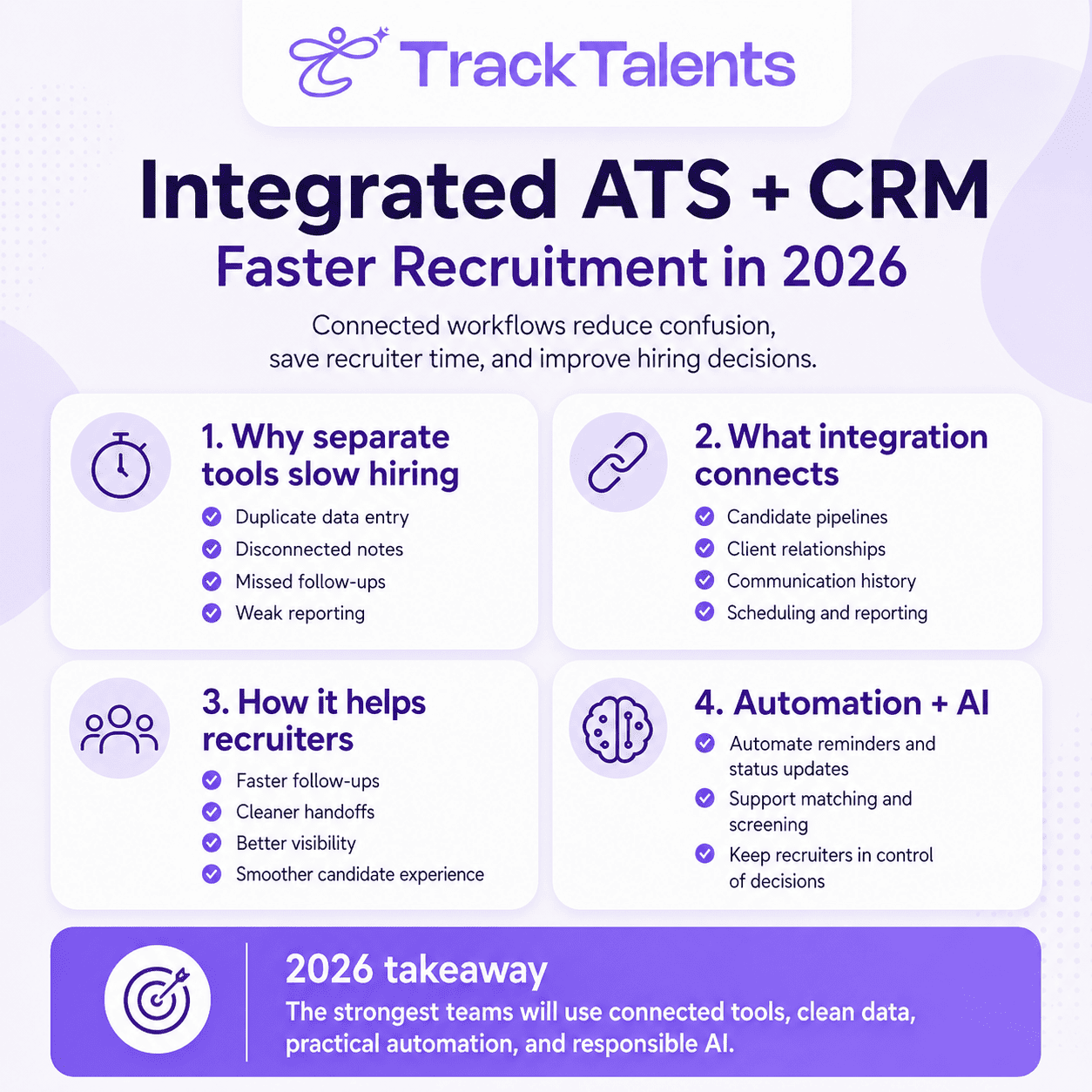
TrackTalents, for example, acts as a customizable ATS for recruiters, staffing agencies, and HR teams, with features around automation, integrations, candidate management, bulk mailing, resume management, communication tracking, and recruitment workflows.
For GCC hiring teams and staffing agencies, tools like this are useful for creating clean records throughout the hiring journey. The tool itself does not guarantee better hires. The value depends on how consistently recruiters and hiring managers use the system.
A Simple Quality-of-Hire Formula for GCCs
GCCs can start with a simple score:
Quality of Hire Score = Performance Score + Retention Score + Manager Satisfaction Score + Time-to-Productivity Score ÷ 4
Each score can be measured on a 100-point scale.
Performance score
Does the new hire meet role-specific expectations after 90 or 180 days?
Retention score
Did the employee stay through the expected early period?
Manager satisfaction score
Is the manager’s feedback structured, specific, and linked to the first success profile?
Time-to-productivity score
Did the hire reach the expected contribution within the planned ramp-up time?
This formula is not perfect. But it gives GCCs a starting point. The most important rule is consistency. Use the same formula across similar roles, then improve it over time.
For leadership roles, add stakeholder feedback and business impact.
For technical roles, add delivery quality, code quality, system reliability, or technical output.
For recruitment roles, add source quality, conversion rate, candidate experience, and hiring manager satisfaction.
What Staffing Agencies Should Learn From Quality-of-Hire Data
Staffing agencies that support GCCs should not measure success only by submissions, interviews, and closures.
They should track what happens after placement wherever clients allow it.
An agency that knows which profiles stay, perform, and ramp faster becomes more valuable than one that only sends resumes quickly. This is especially important in GCC hiring, where clients need niche skills, global delivery maturity, communication ability, and sustained reliability.
Agencies should ask clients for structured feedback after 30, 60, and 90 days. They should analyze which sources, recruiters, screening questions, and assessment methods produce better outcomes.
They should also be honest when a role’s salary, location, notice period expectations, or skill mix is likely to reduce hiring quality.
Quality-of-hire data can move a staffing agency from resume supplier to talent advisor.
What GCC Leaders Should Improve First
GCC leaders do not need a complex model on day one. They can begin with a few practical changes.
1. Define success before sourcing
Do not start the search until the hiring team knows what good performance will look like after joining.
2. Use structured screening
Evaluate candidates against the work, not only against keywords.
3. Build consistent interview rubrics
Panels should score using the same criteria and scale.
4. Run 30/60/90-day reviews
Use early reviews to measure both employee ramp-up and hiring-process accuracy.
5. Track source quality
Reward sources that produce strong hires, not just high resume volume.
6. Keep ATS data clean
Incomplete notes, missing sources, and scattered feedback weaken future hiring decisions.
7. Make hiring managers accountable
Recruiters do not own the quality of hire alone. Hiring managers must share responsibility for the quality of selection and the success of onboarding.
The Future of GCC Hiring Will Be Measured After Joining
GCC growth in India will continue to create demand for AI, analytics, cybersecurity, product engineering, cloud, finance operations, HR technology, and recruitment talent.
But speed alone will not protect delivery.
The next stage of GCC hiring maturity will depend on connecting what happens before the offer with what happens after joining.
Which candidates succeed?
Which sources work?
Which interviews predict performance?
Which assessments fail?
Which managers select well?
Which roles need stronger onboarding?
Quality of hire helps answer these questions. It moves hiring from activity reporting to business evidence.
A hiring mistake becomes expensive when the system notices the problem too late. A stronger hiring system measures quality early, learns from every hire, and improves the next decision before the same mistake repeats.
Frequently Asked Questions
What is the quality of hire in GCC hiring?
Quality of hire measures how well a new employee performs after joining a Global Capability Center. It can include performance, retention, time to productivity, hiring manager satisfaction, role-specific output, and stakeholder responses.
Why is quality of hire important for GCCs?
GCCs often handle high-value work such as engineering, AI, cybersecurity, analytics, finance operations, and global delivery. A weak hire in a key role can affect project schedules, manager bandwidth, team productivity, and stakeholder trust.
How can GCCs calculate the quality of hire?
A simple formula can combine performance score, retention score, manager satisfaction, and time-to-productivity score. GCCs can add role-specific standards such as delivery quality, technical output, customer impact, or stakeholder responses.
Is the 30% bad-hire cost rule reliable?
It should not be treated as a universal rule. Hiring cost depends on role level, skill rarity, notice period, replacement speed, training time, and business impact. A role-specific cost model is more useful than a fixed percentage.
What are early signs of weak hiring quality?
Usual signs include early attrition, repeated manager correction, delayed productivity, poor output quality, team friction, weak stakeholder feedback, and a mismatch between the promised role and the actual work.
How can staffing agencies improve the quality of hire for GCC clients?
Staffing agencies can improve quality by clarifying success profiles, using structured screening, tracking post-placement feedback, analyzing source quality, and advising clients when salary, location, or skill expectations may limit candidate quality.
How does an ATS support quality-of-hire measurement?
An ATS helps capture pre-hire data such as candidate source, resume version, screening notes, interview feedback, assessment results, offer details, and joining status. When this data is linked to post-hire outcomes, GCCs can see which hiring decisions yield stronger employees.