Recruitment marketing helps potential candidates discover a role, understand the employer, and decide whether applying is worth their time. It includes job advertising, careers pages, social media, employee stories, paid campaigns, talent communities, and recruiter outreach.
Its purpose is not simply to generate more applications. It should attract people who understand the opportunity, meet the essential requirements, and are willing to continue through the hiring process.
Problems arise when the campaign promises clarity, flexibility, or a strong employee experience, but the actual process delivers vague job information, hidden pay, a lengthy application process, and weeks of silence. Better graphics and wider reach cannot repair that contradiction.
Recruitment marketing works when the message and the hiring process support each other. Candidates should receive the same clear and credible experience from the first advertisement to the final decision.
Recruitment Marketing Starts Before a Vacancy Becomes Urgent
Many hiring teams begin recruitment marketing only after a vacancy opens. The recruiter receives an urgent requirement, publishes a job advertisement, and starts posting across several channels.
At that point, the organization is asking candidates to understand the role, trust the employer, and apply with little prior knowledge.
A better approach is to build familiarity before the hiring need becomes critical.
Companies that repeatedly recruit software developers, nurses, sales professionals, accountants, or customer-service employees can publish useful information throughout the year. This may include:
- Explanations of common roles
- Employee career stories
- Details about training and progression
- Information about the interview process
- Workplace and location guidance
- Examples of projects or customer problems
- Answers to questions candidates regularly ask
Staffing agencies can follow the same approach. An agency that frequently hires for similar occupations should already know which skills are scarce, which salary ranges attract responses, which concerns cause candidates to withdraw, and which channels produce suitable applicants.
This preparation reduces dependence on last-minute advertising. It also provides recruiters with content and candidate relationships they can use when a new requirement arises.
Recruitment marketing therefore needs two timelines:
Always-on activity builds recognition, recruiter credibility, and reusable talent communities.
Vacancy-specific campaigns promote an immediate opportunity to a defined group of candidates.
Without the first, every urgent vacancy starts from zero.
More Views Do Not Always Produce Better Applicants
Reach is easy to measure. Hiring value is harder.
A campaign may generate thousands of impressions and hundreds of clicks without producing candidates who meet the role criteria. The advertisement may be reaching the wrong audience, creating wonder without sufficient detail, or attracting applicants whose expectations do not match the opportunity.
SHRM’s 2025 Talent Trends research illustrates the difference between usage and effectiveness. Fifty-five per cent of surveyed organizations had used social media to connect with candidates, making it the most commonly used recruitment strategy. However, social media did not appear among the approaches HR professionals considered most effective.
Flexible working arrangements and improved compensation were each selected as effective by 61% of respondents. A simpler application process was selected by 49%, while 48% identified voluntary pay-range disclosure. The survey included 2,040 respondents.
The lesson is not that social media lacks value. Social platforms can raise awareness, reach passive candidates, and highlight aspects of the workplace that are difficult to convey in a job advertisement.
The problem comes from treating visibility as the final objective.
Candidates may discover a vacancy through a LinkedIn post and still decide against applying because:
- The salary is unclear
- The role description is generic
- The work arrangement is uncertain
- The application takes too long
- The employer has a weak reputation
- The hiring stages are not explained
- The responsibilities do not justify the requirements
Recruitment marketing must highlight a worthwhile, clearly presented opportunity. It should not be used to distract candidates from weaknesses in the role.
Build Candidate Personas From Hiring Evidence
Candidate personas can help recruitment teams decide what to say, where to advertise, and which concerns to address. They become unhelpful when they are based on stereotypes.
Descriptions such as “ambitious professional,” “digital native” or “growth-oriented candidate” reveal little about how someone chooses a job.
A useful candidate persona should explain:
- Where suitable people currently work
- Which job titles they may use
- What skills and experience they possess
- Which locations can they consider
- What information influences their decision
- Which objections may stop them from applying
- Which channels they use during a job search
- What would persuade them to respond to a recruiter
- Which parts of the hiring process may create difficulty
Different candidates evaluate opportunities differently.
A senior software engineer may want to know about architecture, engineering standards, technical debt, product ownership, and the interview process.
A warehouse supervisor may focus on location, shift hours, transport, overtime, team size, and physical working conditions.
A healthcare recruiter may compare client types, vacancy volumes, incentive structure, remote-working arrangements, ATS quality, and escalation support.
The strongest evidence usually comes from previous hiring activity. Recruitment teams can review:
- Successful placements and hires
- Candidate withdrawal reasons
- Rejected offers
- Source performance
- Interview feedback
- Salary discussions
- Questions asked during screening
- Application drop-off
- Recruiter notes
- Retention after joining
This analysis may reveal that the organization has misunderstood its audience.
For example, a campaign may emphasize office culture while candidates are mainly asking about career progression and workload. A staffing agency may promote commission potential, while experienced recruiters want to know whether client requirements are properly qualified.
Personas should guide the message, not invent the candidate.
Write Job Ads That Help People Make a Decision
A job advertisement should provide suitable candidates with enough information to decide whether the opportunity warrants further consideration.
It should not be a shortened internal job description filled with broad duties, personality traits, and unexplained company language.
Google’s JobPosting guidance requires the description to represent the complete job. It identifies responsibilities, qualifications, skills, working hours, education, and experience among the details that may be needed. Google also prohibits misleading information, false locations, expired vacancies, and keyword stuffing.
A useful job advertisement normally covers:
- A recognizable job title
- The purpose of the role
- Main responsibilities
- Key skills and experience
- Preferred qualifications
- Location
- Remote, hybrid or on-site arrangement
- Working hours or shifts
- Salary range where available or required
- Travel or physical requirements
- Reporting line
- Major benefits
- Hiring stages
- Application instructions
The advertisement should separate essential criteria from preferences. Long lists of “requirements” can discourage suitable candidates when many items are merely desirable.
Inflated language also reduces clarity. Phrases such as “rockstar,” “ninja,” “visionary disruptor” and “world-class opportunity” tell candidates little about the work.
Creativity is useful when it makes the role easier to understand. It becomes a problem when it replaces practical information.
The careers page should answer the following questions.
After reading the job advertisement, candidates may visit the employer’s website to decide whether the company appears credible.
A useful careers page can explain:
- What the organization does
- Who its customers are
- Where teams work
- What the hiring process includes
- How learning and progression operate
- Which benefits are available
- How flexible work is managed
- How candidates can request an accommodation
- How applicant information is used
The page should also work properly. Jobs need to be up to date, searchable, and easy to open on a phone. Candidates should not need to create an account merely to read the complete description.
For staffing agencies, trust requires slightly different information. The end client may remain confidential at the first stage, but the agency can still explain the industry, location, work model, salary, responsibilities, and hiring process.
Candidates should also know who will contact them and what happens after they apply.
Choose Channels Based on the Candidates You Need
There is no recruitment channel that works equally well for every occupation.
LinkedIn may be suitable for professional roles, specialist searches, recruiter outreach, and employer thought leadership. Facebook can support local and community-based hiring. Instagram may help with visual workplace content and early-career campaigns. YouTube allows employers to explain roles and working environments in more depth. TikTok may suit certain campus, retail, hospitality, creative, and high-volume campaigns.
Job boards continue to play an important role for candidates who are actively searching. Employee referrals can build trust and reach people who do not frequently check job advertisements. Search advertising may help when candidates are looking for a specific job in a specific location.
The channel is supposed to follow the hiring problem.
Before investing in a platform, ask:
- Does the target audience use it for career information?
- Can the campaign target the right skills, location or occupation?
- Does the channel produce applicants or only engagement?
- Can candidate sources be tracked through the ATS?
- Does the format suit the information candidates need?
- Can the recruitment team reply promptly to interest?
Posting the same image and caption across every platform is distribution, not a channel strategy.
Content should also reflect how people use each platform. A detailed professional insight may work on LinkedIn. A short workplace video may suit Instagram. A local hiring post may perform better in a Facebook community group.
The role and audience should shape the channel, format, and message.
Measure the Journey From Click to Hire
Impressions, video views, and click-through rates show whether people noticed a campaign. They do not show whether the campaign contributed to a hire.
Recruitment marketing needs full-funnel measurement.
Appcast’s 2025 benchmark analyzed 2024 job-ad data from more than 1,300 US employers, covering 379 million clicks and more than 30 million applications. It examined cost per click, application, and hire across industries and locations.
The 2026 benchmark places additional emphasis on click-to-hire data across each stage of the funnel. The aim is to help employers judge channels by downstream quality rather than top-of-funnel volume alone.
A practical recruitment marketing funnel may include:
| Stage | Useful measure |
| Advertisement shown | Impressions and reach |
| Candidate shows interest | Click-through rate |
| Candidate begins applying | Application-start rate |
| Candidate submits | Completion rate |
| Recruiter reviews application | Qualified-applicant rate |
| Candidate passes screening | Source-to-screen conversion |
| Candidate interviews | Source-to-interview conversion |
| Candidate receives an offer | Interview-to-offer conversion |
| Candidate accepts | Offer-acceptance rate |
| Candidate joins | Cost per hire |
| Candidate remains | Retention by source |
Cost per application can be misleading when one channel produces many unsuitable applications. Cost per qualified applicant often provides a better comparison.
Suppose one campaign produces 500 applications at ₹200 each, but only 20 pass screening. The cost per qualified applicant is ₹5,000.
Another produces 100 applications at ₹400 each, with 25 passing screening. Its application cost is higher, but its cost per qualified applicant is ₹1,600.
The second campaign creates more hiring value despite attracting fewer applications.
Recruitment teams should analyze channel performance by role. A source that works well for customer-service hiring may perform poorly for specialist engineering positions.
Keep the Marketing Promise Through the Hiring Process
Recruitment marketing creates an expectation. Candidate experience tests whether that expectation was accurate.
A company may promote respect while leaving candidates without updates. It may advertise flexibility while interviewers provide conflicting information about office attendance. It may describe a fast-moving culture but allow the hiring decision to remain pending for weeks.
These gaps weaken trust.
The candidate journey should support the campaign at each stage.
Application
The form should be mobile-friendly, focused, and proportionate to the role. Candidates should not upload a résumé and then re-enter the same information without a clear reason.
Confirmation
Applicants should receive an acknowledgment that identifies the correct role and explains what happens next.
Screening
Recruiters should give an accurate account of the work, salary, location, schedule, and selection process.
Interviews
Candidates should receive definite instructions, interviewer details, and preparation expectations. Interviewers should understand the role and avoid contradicting one another.
Feedback and decisions
Candidates need timely closure. Not every applicant can receive personal feedback, but people should not remain indefinitely in an active process after a decision has been made.
Offer
The final terms must match the information communicated during recruitment. Major changes introduced at the offer stage can undo the trust built by the campaign.
Recruitment marketing and recruiting cannot operate as separate functions. The people promoting the employer and the people managing candidates need shared information, agreed messages, and a clear handover.
Use AI Without Making Recruitment Content Sound Artificial
AI can help recruitment teams draft job advertisements, create message variations, analyze campaign results, and organize candidate segments.
LinkedIn’s 2025 Future of Recruiting report found that 37% of surveyed recruitment organizations were actively integrating or exploring generative AI, up from 27% the previous year. Among teams using or testing it, the reported average time saving was about 20% of the working week. The findings were based partly on a survey of more than 1,000 talent professionals.
Time saving does not guarantee better content.
AI-generated recruitment material often becomes:
- Too long
- Repetitive
- Filled with generic claims
- Inconsistent with the actual role
- Overloaded with keywords
- Similar to competing employers’ content
- More polished than informative
Every AI-assisted job advertisement and candidate message needs human review. Recruiters should confirm that the duties, requirements, salary, work model, and employer claims are correct.
Candidate trust also deserves attention. A Gartner survey conducted in the first quarter of 2025 among 2,918 candidates found that only 26% trusted AI to evaluate them fairly. 52% believed AI was screening their application information, and 25% said they trusted employers less when AI was used to evaluate them.
Recruitment marketing should not make unsupported claims that AI creates an entirely objective hiring process. Where automated tools affect screening, matching, or assessment, candidates should receive appropriate information about the process and the role of human review.
AI is most useful when it reduces routine work while leaving responsibility for accuracy, judgment, and communication with the recruitment team.
Build Candidate Communities That Provide More Than Job Alerts
A talent community should not be a large mailing list that receives every available vacancy.
Candidates are more likely to remain engaged when communication reflects their skills, location, interests, and career stage.
A staffing agency might create separate groups for:
- Software engineers
- Healthcare professionals
- Finance and accounting candidates
- Recruiters
- Sales professionals
- Graduates
- Contract workers
- Leadership candidates
Relevant communication may include:
- Suitable vacancies
- Market and salary updates
- Interview guidance
- New skill requirements
- Hiring-event invitations
- Career-development information
- Regulatory or certification updates
- Recruiter contact details
Employee and recruiter advocacy can support this work.
Employee stories are more credible when they explain real experiences, such as how onboarding worked, what a team delivered, or how someone moved into a new role.
Recruiters can build authority by sharing market observations, interview advice, and realistic information about the occupations they handle. Not every post needs to promote a vacancy.
The aim is to create familiarity and usefulness before asking the candidate to apply.
Connect Recruitment Campaigns to the ATS
Recruitment marketing creates candidate activity across job boards, social platforms, career pages, referrals, emails, and recruiter outreach.
Without a shared system, the team may not know:
- Where the candidate came from
- Which campaign generated the application
- Which message received a response
- Whether the candidate was contacted previously
- Why the person withdrew
- Which stage has the candidate reached
- Whether the profile suits future roles
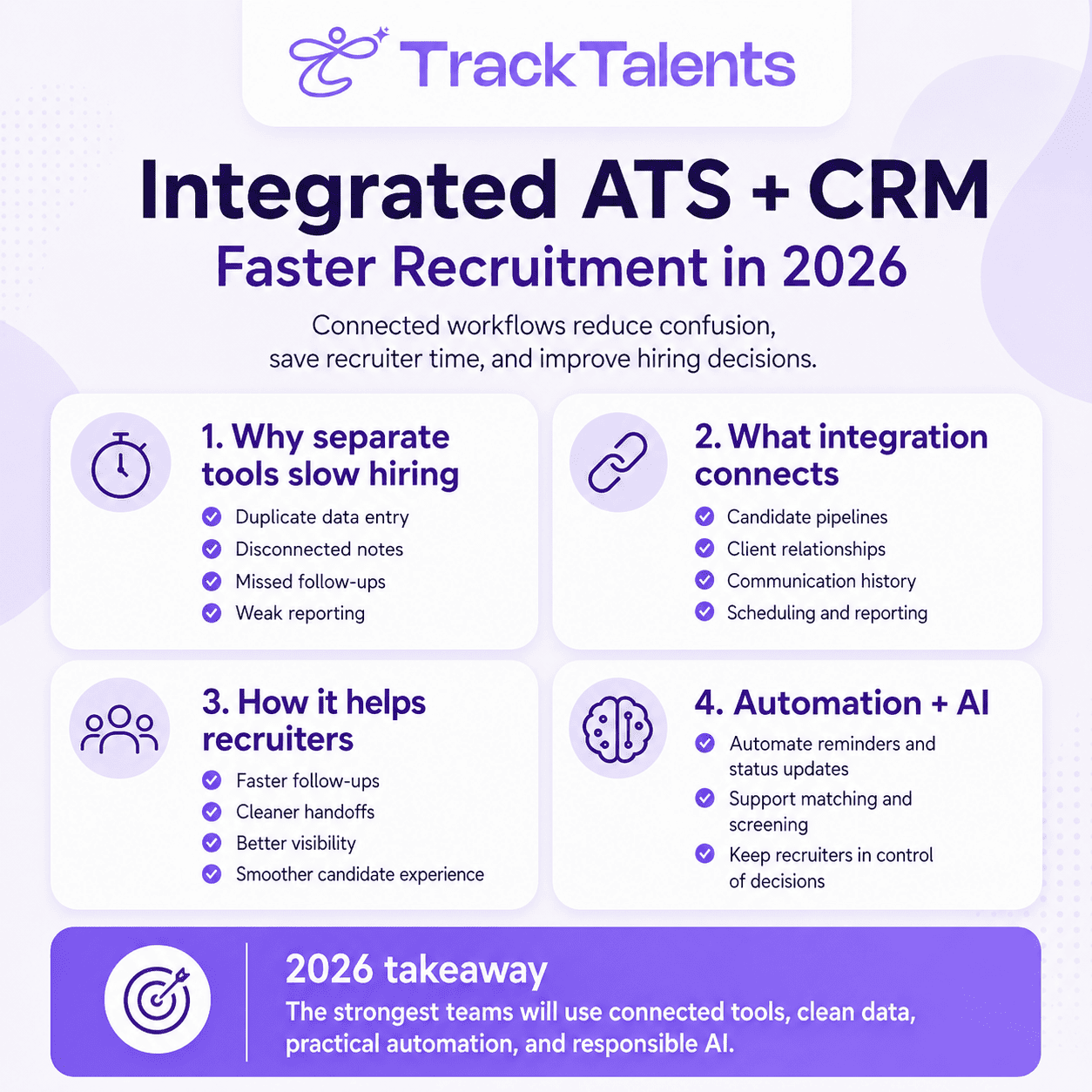
An ATS or recruitment CRM can connect campaign activity to hiring outcomes.
TrackTalents, for example, lists one-click posting to free and premium job boards, a branded career portal, centralized job records, bulk mailing, résumé management, and linked candidate communication among its published features. It also states that recruiters can connect candidates, contacts, vendors, and jobs through its CRM functions and track email activity and interviews in one place.
These functions can support recruitment marketing by helping teams:
- Record candidate source
- Connect applications to specific jobs
- Track campaign responses
- Segment previous candidates
- Send appropriate follow-up communication
- Review source-to-interview performance
- Revisit suitable candidates for new roles
The platform cannot correct an unclear job, an unsuitable salary, or a slow client decision. It can provide the data needed to see where candidate interest is being lost.
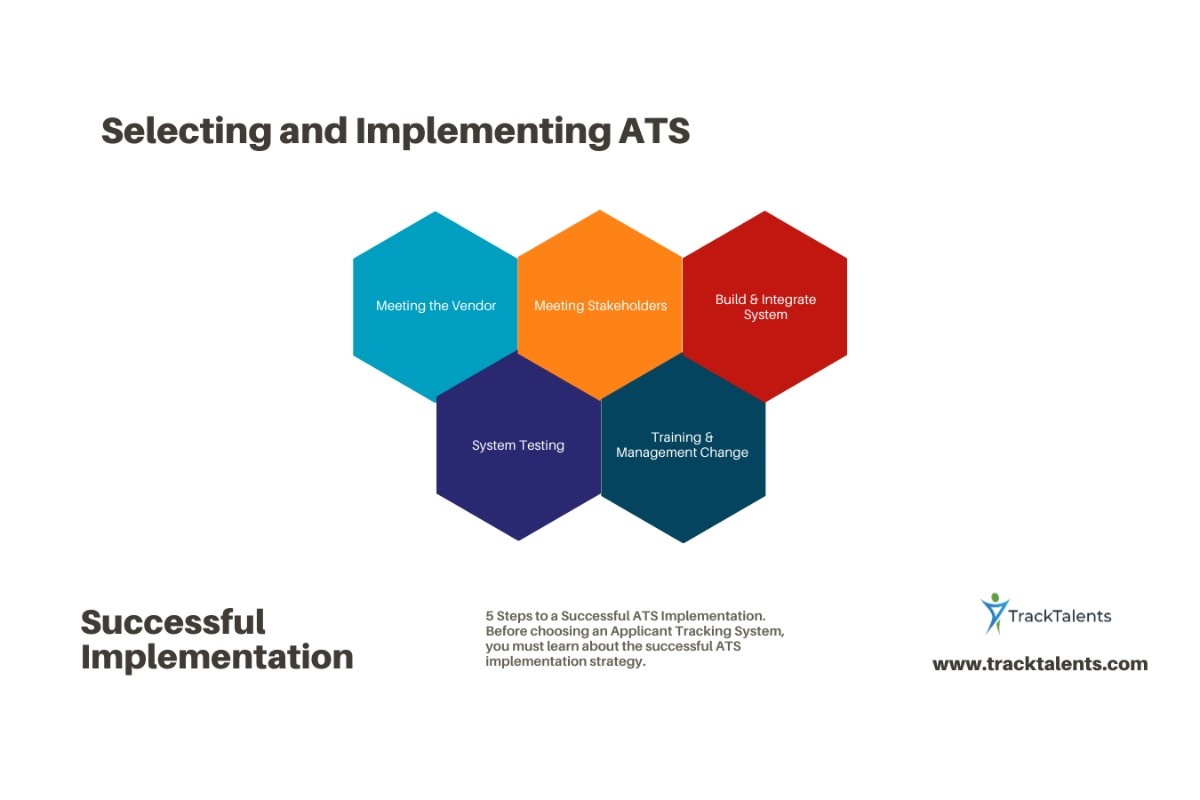
Implementation also matters. Recruitment teams need consistent source names, campaign codes, candidate statuses, and withdrawal reasons. Poorly maintained data will produce misleading reports regardless of the software used.
A Practical Recruitment Marketing Plan
A workable recruitment marketing program can be built in eight steps.
1. Choose the hiring priorities
Identify roles that are recurring, difficult to fill, commercially important, or likely to become urgent.
2. Review previous hiring data
Study candidate sources, placement history, interview conversion, offer rejection, salary discussions, and withdrawal reasons.
3. Define the target candidate
Describe the skills, location, motivations, objections, and information needs using hiring evidence instead of assumptions.
4. Improve the opportunity
Confirm the salary, work model, responsibilities, requirements, and interview process before promoting the role.
5. Prepare useful content
Create job advertisements, careers-page information, recruiter posts, employee stories, and candidate guidance that address real questions.
6. Select the channels
Employ platforms based on candidate behavior, role type, location, and previous source performance.
7. Connect the campaign to recruitment
Make sure recruiters can identify the campaign, respond quickly, and keep consistent information throughout screening and interviews.
8. Review the complete funnel
Measure qualified applicants, interviews, offers, hires, retention and cost—not only clicks and applications.
Campaigns that attract attention but fail to produce suitable candidates need better targeting or clearer information. Campaigns that produce qualified applicants who later withdraw may reveal a problem in the hiring process rather than the marketing.
Recruitment Marketing Should Make the Opportunity Easier to Trust
Recruitment marketing is not a way to make every employer or vacancy look attractive.
Its more credible purpose is to help suitable candidates understand what is being offered, decide whether it matches their needs, and move through the hiring process free of unnecessary confusion.
That requires more than social posts and paid advertising. It requires:
- Accurate job information
- Relevant candidate targeting
- Clear pay and work arrangements
- Simple applications
- Consistent recruiter communication
- Honest employer stories
- Full-funnel measurement
- Reliable ATS data
- A hiring process that delivers what the campaign promised
Candidates do not apply merely because a company describes itself as a great place to work. They apply when the role appears relevant, the information feels credible, and the next step seems worth their time.
The campaign may create the first impression. The hiring process decides whether candidates believe it.
Frequently Asked Questions
What is recruitment marketing?
Recruitment marketing uses content, advertising, employer branding, targeting, and measurement to attract and connect with potential candidates. It may include job advertisements, careers pages, social media, paid campaigns, talent communities, and recruiter communication.
How is recruitment marketing different from recruiting?
Recruitment marketing builds awareness and interest. Recruiting manages candidate selection through sourcing, screening, interviews, decisions, offers, and onboarding. The two functions need to remain connected because marketing promises shape candidate expectations.
Which recruitment marketing channels work best?
The right channel depends on the role, location, and target candidate. LinkedIn may suit professional hiring; job boards may reach active applicants; social media can support awareness; employee referrals can add trust, and paid advertising can increase targeted reach.
What should recruitment marketing teams measure?
Useful measures include click-through rate, application completion rate, qualified applicant rate, screening conversion rate, interview conversion rate, offer acceptance rate, cost per qualified applicant, cost per hire, and retention by candidate source.
Can staffing agencies use recruitment marketing?
Yes. Agencies can use it to attract candidates for recurring roles, establish recruiter credibility, build segmented talent communities, and reduce dependence on urgent sourcing after a client releases a vacancy.
How does an ATS support recruitment marketing?
An ATS can record candidate sources, connect applications to campaigns, track movement through the hiring process, and identify which channels produce qualified candidates, interviews, and hires.
Should recruitment teams use AI for marketing content?
AI can support drafting, campaign analysis, segmentation, and outreach. Recruiters should verify every factual claim, remove generic language, and appropriately disclose the use of AI when it affects candidate screening or evaluation.