“Revenge quitting” is a dramatic term for a resignation intended to express anger, expose a workplace problem, or inconvenience an employer. The employee may leave with little notice, resign during a critical project, announce the departure publicly, or make it clear that the timing is deliberate.
For recruiters and staffing agencies, the phrase is useful only when it leads to better questions. A disruptive resignation may point to poor screening, but it can also expose an inaccurate job description, weak management, broken promises, unfair treatment, or an onboarding process that failed to prepare the new hire.
Replacing the employee without examining those conditions may lead the next person into the same problem. Agencies can also face a reopened search, a free replacement under the guarantee clause, strained client relationships, and reduced candidate trust.
Recruiters cannot prevent every resignation. They can reduce avoidable ones by qualifying roles more carefully, recording what was promised, and staying involved after the joining date.
Not Every Sudden Resignation Is Revenge Quitting
Revenge quitting is an informal worksite label, not a formal HR or legal category. It should not be used for every employee who leaves abruptly. But at the same time Human resources should be able to analyze the pattern.
People may resign quickly because of:
- A family or health emergency
- Relocation
- Visa or work-authorization problems
- An immediate joining date with another employer
- Safety concerns
- A serious workplace dispute
- A personal situation they do not wish to disclose
The “revenge” element appears when the employee intends the resignation to communicate dissatisfaction or make the organization experience the consequences of unresolved concerns.
A 2025 Software Finder survey of 1,007 full-time employees found that 17% reported having engaged in revenge-quitting in the past, and 28% expected it to occur in their workplace that year. However, only 4% said they planned to do it in 2025. The survey relied on self-reported responses and should not be treated as a measure of the entire workforce, but it does show that the behavior is visible without being normal for most employees.
It also differs from quiet quitting. Quiet quitting generally refers to an employee remaining in the job while withdrawing extra effort or emotional commitment. Revenge quitting ends the employment relationship and uses the departure itself to send a message.
Recruiters should therefore avoid treating the phrase as a diagnosis. The more useful question is not whether an exit qualifies as revenge quitting. It is whether the resignation exposed a problem that could affect the next placement.
The Problem May Start Before the Employee Joins
Some retention failures begin during the recruitment process.
A role may be advertised as strategic but turn out to be mainly administrative. A hybrid arrangement may become office-based after the employee joins. A manageable workload may depend on a team that is already understaffed. A promised path to promotion may have no defined criteria, budget, or precedent.
These gaps are not always deliberate. Recruiters may receive incomplete information from the client, while hiring managers may describe how they hope the role will develop rather than how it currently operates.
Pressure to fill a vacancy can make the problem worse. Difficult details are softened because the recruiter fears losing the candidate. The person joins with one understanding of the job and discovers another.
Before advertising a role, the recruiter should ask:
- Why is the position open?
- Why did the previous employee leave?
- How long did that person remain in the role?
- Which duties will take most of the employee’s time?
- What should the new hire achieve in the first 90 days?
- Which part of the role has caused previous employees’ difficulty?
- What is the manager’s working and communication method?
- How large is the present workload?
- Which salary, flexibility and benefit details are formally approved?
- What may change after the person joins?
- Which career-development opportunities have actually been used by employees?
- What should never be promised to candidates?
A client may not have a perfect answer to every question. Repeatedly vague or contradictory responses are still useful information. They tell the recruiter where expectations need to be clarified before the vacancy reaches the market.
Qualify the Job Carefully
Recruitment processes often examine the candidate in detail while accepting the employer’s description with limited challenge.
Candidates are asked to prove their skills, explain career gaps, and provide examples of past performance. Employers should also be expected to explain what the role requires, how success will be judged, and what support the person will receive.
A role can fail a suitable candidate when it is:
- Poorly defined
- Underpaid for the actual workload
- Managed differently from what was described
- Dependent on unavailable resources
- Burdened by unclear reporting lines
- Advertised with flexibility that does not exist
- Presented as a growth opportunity without a realistic path
- Repeatedly vacated for the same unresolved reason
This does not mean recruiters should assume every employee complaint is accurate or every client is at fault. It means both sides of the placement deserve proper assessment.
Recruiters should also compare what different client stakeholders say. Human resources may describe the role one way, while the hiring manager gives a different account. The approved job description may conflict with interview discussions or the compensation range.
Those differences should be resolved before an offer is issued.
Onboarding Shows Whether the Recruitment Promise Was Accurate
An accepted offer does not prove that the match was successful.
The first days of employment reveal whether the candidate received an accurate picture of the job. The employee sees the real workload, reporting structure, management approach, systems, team functioning, and access to training.
SHRM defines onboarding as the process of integrating new employees into the organization and supplying them with the tools and information needed to become productive. Its guidance emphasizes that the first days and months may determine if new employees remain with the organization.
Warning signs can appear quickly:
- Equipment or system access is not ready
- Nobody explains the first week’s priorities
- The manager is unavailable
- Responsibilities differ from the interviews
- Working hours or location expectations change
- The new hire receives little training
- The team is unaware that the person is joining
- Performance expectations are unclear
- Work is assigned without the promised resources
- Compensation or benefit details remain unresolved
One administrative delay does not indicate a retention crisis. Several failures, especially when combined with a job that differs from the recruitment description, can make the employee question the decision to join.
Recruiters should agree with clients before placement about who owns onboarding and what the new hire should experience during the first month. A staffing agency cannot run the client’s workplace, but it can check whether the conditions discussed during recruitment have been provided.
Post-Placement Check-Ins Should Have a Clear Purpose
Many agencies contact the candidate on the first day and then remain silent unless a problem occurs.
A more useful approach is to schedule brief check-ins at defined stages. The conversation should not be a general “How is everything going?” call. It should compare the employee’s experience with the role that was presented.
| Check-in | Questions for the candidate | Questions for the manager |
| First week | Was the role, reporting line and working arrangements as expected? Do you have the access and information needed? | Has the employee started the agreed work? Are there any immediate support needs? |
| 30 days | Does the day-to-day role match the interview discussions? Are workload and priorities clear? | Is the employee progressing as expected? Has useful feedback been provided? |
| 60 days | Are any concerns developing around management, workload, flexibility or team support? | Are there performance or role-clarity issues that need early action? |
| 90 days | Can the employee see a realistic future in the role? Have any recruitment promises remained unresolved? | Is the placement meeting the original need? What support or adjustment is required? |
These conversations should remain proportionate. The recruiter is not replacing the employer’s manager or HR function. The purpose is to identify a mismatch before it leads to a resignation or a formal dispute.
Important points should be recorded with the candidate’s privacy in mind. Sensitive personal information should not be copied into general notes without a legitimate need and suitable access controls.
Career Stagnation Can Turn Patience into Resentment
Career growth is frequently included in job advertisements but rarely explained in practical terms.
Candidates may hear that a company offers “excellent progression” without being told:
- Which roles they can move into
- What skills they need to demonstrate
- Who approves promotion
- How often career reviews take place
- Whether a training budget exists
- How internal vacancies are communicated
- How long does the progression usually take
- Whether recent employees have moved internally
Glassdoor reported that about two-thirds of professionals on its platform felt stuck in their careers heading into 2025. Its career-opportunity ratings fell by 3% between 2022 and 2024 and remained almost unchanged among current employees during the first part of 2025.
These figures do not prove that stalled careers cause revenge quitting. They help explain why vague promises about development may become a source of frustration when employees already feel they have limited options.
Broader engagement data also points to workplace strain. Gallup’s 2026 State of the Global Workplace report found that global employee engagement fell to 20% in 2025, its lowest level since 2020. The report used data from 141,444 employed respondents collected across more than 140 countries and territories during 2025.
Recruiters should not use those findings to predict an individual’s behavior. They should use them as a signal that recognition, manager support, meaningful work, and career choice affect whether employees remain committed.
When a client cannot describe a realistic development path, the recruiter should present the role on its current merits rather than promise future opportunities that may never appear.
Compensation can create problems for similar Job roles
Employees do not expect every workplace decision to favor them. They do expect decisions to be understandable and reasonably consistent.
Resentment can grow when:
- Similar employees receive different pay without explanation
- Flexible work is permitted selectively
- Promotion criteria change depending on the person
- Extra work repeatedly falls on the same employees
- Some managers ignore rules applied strictly by others
- Concerns are acknowledged but never addressed
- Recognition appears to follow visibility rather than contribution
Recruiters may notice early signs of these problems when clients cannot explain compensation, reporting lines, performance measures, or promotion criteria.
For example, a hiring manager may ask candidates to accept a salary below the market rate while expecting responsibilities normally assigned to a more senior position. The client may advertise hybrid work but refuse to define the required office days. The recruiter may learn that several employees have left the same manager within a short period.
None of these facts alone proves an unfair workplace. Together, they justify deeper questions.
A recruiter who ignores them to protect a quick placement may cause a future replacement problem.
Stay Interviews need to be practiced and applied frequently
Exit interviews happen after the employee has decided to leave. They may explain the failure, but they rarely prevent that resignation.
Stay interviews ask current employees what keeps them in the organization, what frustrates them, and what may eventually cause them to leave. SHRM describes them as a way to uncover problems while managers still have time to act. Its guidance stresses listening, asking follow-up questions, and separating the conversation from a performance review.
Recruiters and staffing agencies can adapt the same approach during post-placement conversations.
Useful questions include:
- Which part of the role has matched your expectations?
- Which part has been different from what you were told?
- What is making the job harder than it needs to be?
- Do you receive enough direction and feedback?
- Is the workload sustainable?
- Have any adaptability, compensation, or development commitments changed?
- Is there anything that might make you reconsider staying?
- What support would make the next few months more successful?
The agency should not promise that the client will grant every request. It should document significant mismatches, raise them through the agreed contact, and confirm what action is realistic.
Asking employees to speak openly without addressing recurring concerns can weaken trust. A check-in program needs an escalation route, not just a questionnaire.
Keep Role and Performance Promises in the ATS and Make it Visible
Recruitment teams lose useful information when candidate expectations remain in personal inboxes, spreadsheets, or unstructured notes.
A candidate may bring up concerns about:
- Remote-work arrangements
- Travel
- Salary progression
- Shift patterns
- Reporting lines
- Notice-period expectations
- Role scope
- Management style
- Training
- Career growth
Those concerns should not disappear once the offer is accepted.
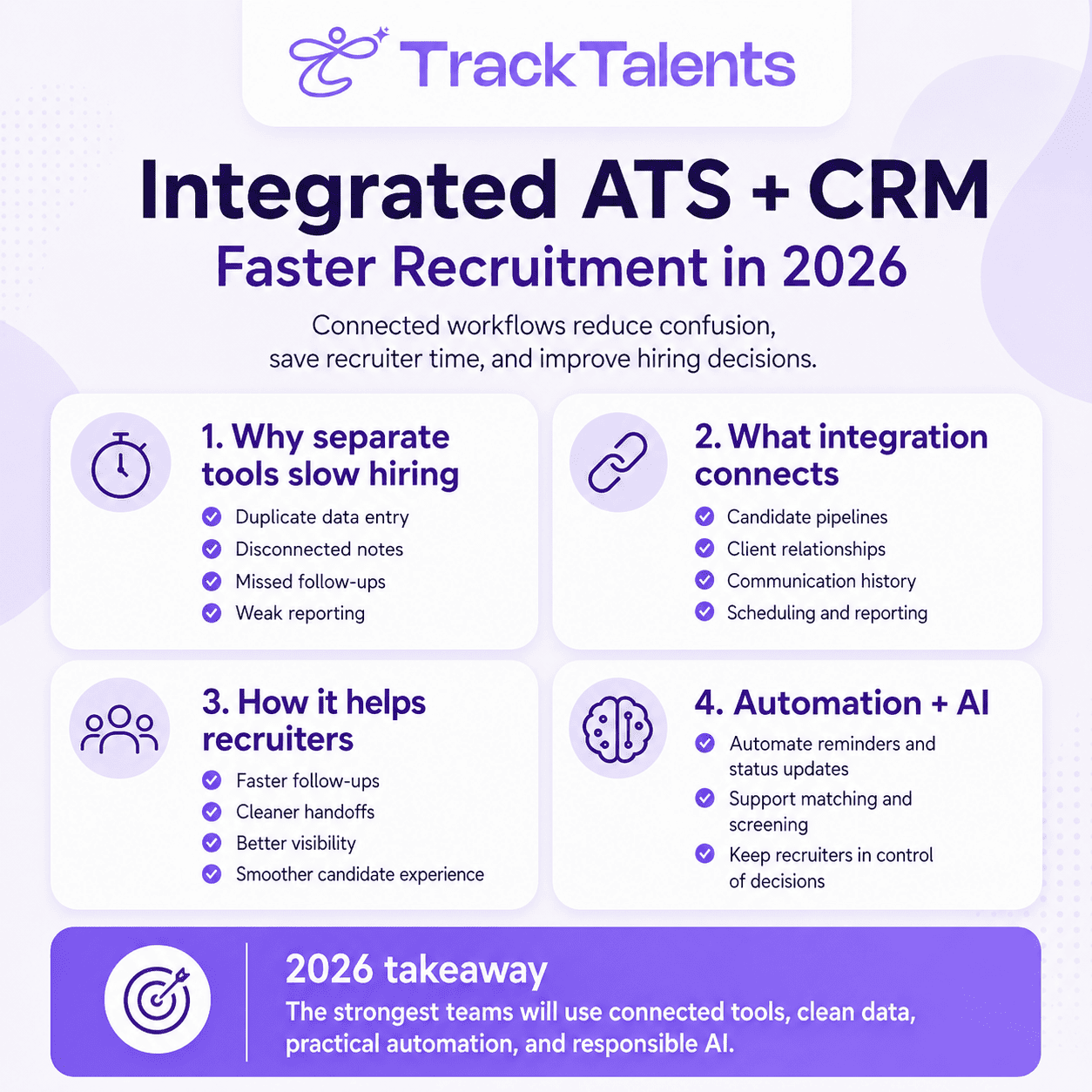
The ATS or recruitment CRM can maintain an agreed-upon record of job details, candidate discussions, interview feedback, offers, and post-placement follow-ups. Software cannot judge whether an employee is resentful, but it can help the recruitment team remember what was said.
TrackTalents, for example, describes functions that link résumés, notes, and interview details to job records. Its published features also include connected candidate, contact, vendor, and job information, email activity tracking, interview scheduling, and onboarding workflows. These functions can support a more traceable placement process when the agency configures and uses them consistently.
A recruiter could record that a candidate accepted the role only after the client confirmed two remote-working days each week. The post-placement check-in can then verify whether that arrangement was honored.
The same system can show whether several employees have left one role, department, or manager during the guarantee period. That pattern is likely to prompt a role review before another candidate is submitted.
Technology does not replace direct conversations or management responsibility. Its value is organizational memory.
Warning Signs Need Immediate Attention and not a lengthy approval
Employees often show symptoms of frustration before resigning, but those signals can have several explanations.
A placed candidate may:
- Turn less responsive during check-ins
- Give vague answers after initially speaking openly
- Report that the work differs from the job description
- Raise the same concern more than once
- Ask whether the agency has other suitable vacancies
- Mention conflicting instructions from managers
- Raise concern about workload or working hours
- Say that the agreed flexibility has changed
- Report receiving no feedback or support
- Question whether remaining in the role is worthwhile
Managers may report declining participation, lower enthusiasm, missed commitments, or withdrawal from team discussions.
Recruiters should not immediately interpret these behaviors as revenge quitting or poor attitude. They may indicate a performance concern, a personal difficulty, a role mismatch, weak management, or a loss of trust.
The response must be factual:
- Clarify what has changed.
- Compare the concern with the agreed role details.
- Identify who can address it.
- Set a date for an update.
- Record the outcome.
- Escalate repeated or serious concerns through the proper client contact.
Recruiters should also recognize the limits of their position. Allegations involving harassment, discrimination, safety, or unlawful conduct require appropriate handling by qualified employer representatives or legal professionals. They should not be reduced to an ordinary retention complaint.
Do Not Search for an immediate replacement
When a person resigns during or shortly after the guarantee period, the fastest response may seem to be republishing the vacancy.
That can repeat the same failure.
Before searching for a replacement, the agency should complete a placement review.
Speak with the departing employee where possible.
The purpose is not to challenge the resignation or persuade the person to withdraw it. Ask what changed between accepting the offer and deciding to leave.
Separate facts from conclusions:
- Which responsibilities differed?
- Were working arrangements changed?
- Was the workload discussed accurately?
- What support was requested?
- How did the manager respond?
- When did the employee first consider leaving?
- What could have been clarified during recruitment?
Review the employer’s account.
Ask the hiring manager:
- What performance or behavior concerns occurred?
- When were they raised with the employee?
- What support or feedback was provided?
- Did the role, team, or priorities change after joining?
- Were any recruitment commitments revised?
- Could the situation have been addressed earlier?
Check the recruitment record.
Compare the job description, intake notes, interview discussions, offer details, and candidate concerns.
Pay particular attention to:
- Compensation
- Location and work model
- Reporting structure
- Core responsibilities
- Working hours
- Travel
- Progression
- Team size
- Resources
- Management expectations
Reassess the vacancy
Determine whether the agency needs to change:
- The job description
- Candidate profile
- Compensation range
- Screening questions
- Interview process
- Onboarding plan
- Replacement terms
- Client expectations
- Decision to continue servicing the role
An agency should be prepared to decline a replacement search when the client refuses to address a repeated and serious cause of early exits.
A recruiter should never flip a side
A deliberately disruptive resignation can be unfair to colleagues, customers, and others who must absorb the work. Employees should normally be encouraged to resign responsibly and protect their own professional reputation.
That does not mean the employer’s conduct should escape review.
Three conclusions can exist at the same time:
- The employee handled the resignation poorly.
- The employer ignored legitimate concerns.
- The recruiter did not investigate the role or communicate it accurately enough.
A useful placement review separates the manner of resignation from its reason.
Automatically blaming the employee may protect the client relationship for the moment, but leave the cause of turnover untouched. Automatically blaming the employer may ignore screening or performance information that the agency should have identified.
The recruiter’s responsibility is not to deliver a quick verdict. It is to establish what happened, improve the next decision, and avoid making claims that the available evidence does not support.
Retention should be included in Placement Quality
Recruitment performance is regularly measured at offer acceptance or joining. Those stages show that a hire occurred and not just a successful placement.
Agencies can acquire a much-needed picture by tracking:
- First-day attendance
- 30-, 60- and 90-day retention
- Completion of the guarantee period
- Early exits by client
- Early exits by manager or department
- Early exits by role type
- Candidate withdrawal reasons
- Differences between advertised and actual duties
- Replacement requests
- Candidate and client complaints
- Repeat placements in the same failed role
- Recruitment promises that were later changed
These measures need context. A resignation due to an unexpected relocation should not be categorized the same way as a departure due to an undisclosed shift pattern.
Exit reasons should be sufficiently specific to guide action without recording unsupported accusations as fact.
An increase in early exits for one client may suggest weak onboarding or role definition. Repeated fall-offs before joining may indicate poor offer management, delayed decisions, or unrealistic candidate expectations. Several complaints about the same promise may show that recruiters are communicating unapproved information.
Retention data helps agencies decide where to improve screening, client qualification, communication, and service terms.
A Placement should not end with a Joining Date
Revenge quitting attracts attention because the resignation is visible. The conditions behind it are often less dramatic: inaccurate expectations, poor onboarding, limited recognition, stalled development, inconsistent treatment, or concerns that were repeatedly ignored.
Recruiters cannot manage every aspect of an employee’s workplace. They can still influence several points where retention risk begins.
They can:
- Describe the role honestly
- Challenge vague client information
- Verify compensation and flexibility
- Record commitments
- Prepare candidates for difficult aspects of the job
- Check whether onboarding corresponds to the offer
- Follow up after placement
- Escalate repeated concerns
- Review patterns in early resignations
- Refuse to repeat a search without examining why it failed
The label “revenge quitting” may eventually disappear from workplace discussions. The recruitment lesson will remain.
A successful placement is not simply a candidate who accepts an offer. It is a candidate who understands the job, enters the right environment, and has a reasonable opportunity to remain and perform.
Frequently Asked Questions
What is revenge quitting?
Revenge quitting is an informal term for resigning in a way intended to express anger, expose a workplace grievance, or deliberately inconvenience the employer. Not every sudden or short-notice resignation should be described this way.
Is revenge quitting the same as quiet quitting?
No. Quiet quitting usually refers to an employee remaining in the job while decreasing discretionary effort or emotional involvement. Revenge quitting involves leaving the organization and using the resignation to communicate dissatisfaction.
What can recruiters do to reduce early resignations?
Recruiters can thoroughly qualify vacancies, verify job details, avoid making unsupported promises, record candidate expectations, check in after candidates join, and review recurring exits linked to the same role, client, or manager.
Should staffing agencies contact candidates after placement?
Yes. Brief, structured conversations during the first week and at 30, 60, and 90 days can identify differences between the advertised role and the employee’s actual experience. Agencies should also obtain feedback from the hiring manager.
How can an ATS help with retention?
An ATS can preserve job details, candidate concerns, interview feedback, communication history, offers, joining information, and post-placement notes. It cannot solve poor management, but it can make commitments and repeated early-exit patterns easier to identify.
What should an agency do after a revenge quit?
The agency should speak with both parties, review what was promised, examine onboarding and management issues, identify the reason for the departure, and revise the role before beginning a search for a replacement. It should not automatically republish the same job description.